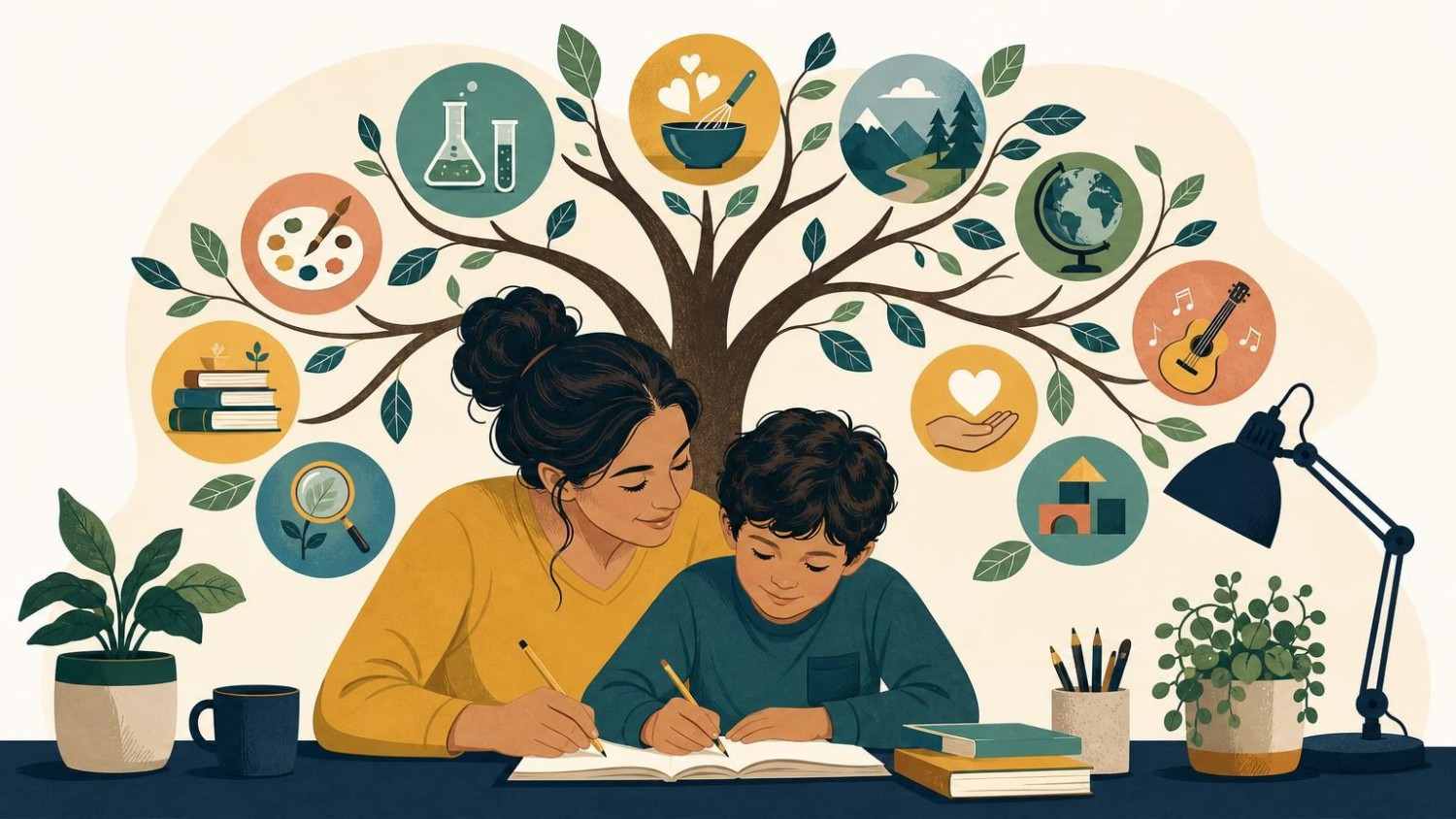
Children spend roughly 1,000 hours a year in school, but they’re awake for nearly 5,000. That gap is enormous, and what happens during those out-of-school hours shapes academic performance just as much as what happens in a classroom. Research from the National Center for Education Statistics consistently shows that parental involvement is one of the strongest predictors of student achievement, regardless of income or background. But “involvement” doesn’t mean hovering over homework or drilling flashcards. The most effective ways to support your child’s learning outside the classroom are often the least obvious: a well-timed question at dinner, a trip to the hardware store, or simply letting your kid see you read a book for fun. Here’s what actually works, based on developmental science and real-world experience, broken into ten practical strategies any family can start using this week.
Cultivating a Positive Learning Environment at Home
The physical and emotional atmosphere of your home has a measurable effect on how well your child absorbs and retains information. A 2024 study published in the Journal of Educational Psychology found that students who reported having a consistent, calm space for studying scored an average of 12% higher on standardized assessments than peers who didn’t. But creating that environment doesn’t require a Pinterest-worthy home office. It requires intention.
The emotional side matters just as much as the physical one. Kids who feel safe making mistakes at home are more willing to take intellectual risks. That means how you respond to a wrong answer or a failed project carries real weight. Instead of “That’s wrong,” try “Interesting: what made you think that?” This kind of response activates the prefrontal cortex, the brain region responsible for reasoning and problem-solving, rather than triggering a stress response in the amygdala.
Designing a Dedicated Study Space
Your child doesn’t need a separate room. They need a consistent spot that their brain associates with focused work. This could be a corner of the kitchen table, a small desk in their bedroom, or even a specific cushion on the floor with a lap desk.
The key elements are minimal distractions, decent lighting, and the supplies they need within arm’s reach. A 2025 survey by Common Sense Media found that 67% of kids aged 8-14 reported being distracted by a nearby phone or tablet during homework. Keep devices out of the study zone unless they’re required for the task. Even having a phone face-down on the desk reduces cognitive capacity by about 10%, according to research from the University of Texas.

Establishing a Consistent Daily Routine
Routines reduce decision fatigue for kids, just as they do for adults. When a child knows that 4:00 p.m. means snack, then reading, then homework, their brain doesn’t waste energy figuring out what comes next. That freed-up cognitive bandwidth goes directly into learning.
The routine doesn’t need to be rigid. Build in flexibility for extracurriculars and off days, but keep the general sequence the same. One common mistake is scheduling homework immediately after school. Most children, especially those under 12, need 30-45 minutes of physical activity or unstructured play before their brains are ready for focused academic work. Their cortisol levels from the school day need time to drop.
Integrating Education into Everyday Activities
Some of the best learning happens when kids don’t realize they’re being taught. Everyday errands and household tasks are packed with opportunities to practice math, reading, science, and critical thinking, all without a worksheet in sight.
Applying Math and Science in the Kitchen
Cooking is essentially an applied science experiment with a snack at the end. Doubling a recipe forces kids to work with fractions. Watching bread rise is a lesson in biology and chemistry. Timing how long it takes water to boil at different altitudes introduces variables and hypothesis testing.
Give your child age-appropriate tasks: a five-year-old can count eggs, a nine-year-old can measure ingredients, and a twelve-year-old can convert a recipe from metric to imperial. Ask questions while you cook together. “What do you think will happen if we add the baking soda now instead of later?” You’re building scientific reasoning skills without a single textbook.
Turning Grocery Shopping into a Literacy Lesson
The grocery store is a goldmine for reading practice and practical math. Younger children can read labels, identify letters, and match items to a written list. Older kids can compare unit prices, calculate discounts, and estimate the total bill before checkout.
One strategy that works well: give your child a budget of $10 and let them plan a snack for the week. They’ll practice reading nutrition labels, doing mental math, and making trade-offs. These are executive function skills, the same ones linked to academic success, and they develop faster through real-world practice than through abstract exercises.
Fostering a Love for Reading and Inquiry
Reading ability is the single strongest predictor of academic success across all subjects, including math and science. But here’s what’s actually happening when a child reads for pleasure: they’re building vocabulary, strengthening neural pathways for comprehension, developing empathy through perspective-taking, and practicing sustained attention. All of this happens automatically, without any instruction.
Modeling Reading Habits for Children
Kids imitate what they see, not what they’re told. If you want your child to read, the most effective thing you can do is let them see you reading. Not on a screen, ideally, but an actual book or magazine. A 2023 study from the American Academy of Pediatrics found that children whose parents read for pleasure at least 20 minutes a day were 2.5 times more likely to be daily readers themselves.
Keep books visible around the house. Talk about what you’re reading at dinner. Visit bookstores together and let your child pick whatever interests them, even if it’s a graphic novel or a book about Minecraft. The goal is volume and enjoyment, not literary sophistication. A child who devours Captain Underpants is building the same neural architecture as one reading Charlotte’s Web.
Encouraging Question-Based Discussions
Instead of asking “What did you learn today?” (which almost always gets “nothing”), try asking questions that spark real conversation. “What’s something that surprised you today?” or “Did anything happen that seemed unfair?” These prompts tap into your child’s natural curiosity and teach them that their observations matter.
When your child asks you a question you don’t know the answer to, resist the urge to Google it immediately. Say, “I’m not sure. What do you think? How could we find out?” This models intellectual humility and teaches the process of inquiry, which is more valuable than any single fact. The hippocampus, the brain’s memory center, encodes information more deeply when it’s discovered through curiosity rather than delivered passively.
Leveraging Community Resources and Field Trips
Your community is full of free or low-cost learning opportunities that most families underuse. Libraries, museums, nature centers, historical sites, and even local businesses can transform abstract school concepts into tangible experiences. Research on experiential learning shows that children retain up to 75% of information they learn through direct experience, compared to just 10% from reading alone.
Maximizing Library and Museum Visits
Most public libraries in 2026 offer far more than books. Many run coding workshops, STEM clubs, language classes, and maker spaces with 3D printers and laser cutters, all free with a library card. If you haven’t visited your local branch recently, check their events calendar online. You might be surprised.
For museum visits, preparation makes a huge difference. Before you go, look up one or two exhibits together and have your child write down three questions they want to answer during the visit. This primes their brain for active learning rather than passive wandering. After the visit, ask them to teach you something they learned. Teaching is one of the most powerful memory consolidation techniques: it forces the brain to organize and articulate information.
Exploring Nature as a Living Classroom
You don’t need to live near a national park. A backyard, a neighborhood pond, or even a patch of weeds growing through a sidewalk crack can become a science lesson. Nature observation builds patience, attention to detail, and classification skills, all foundational for scientific thinking.
Start a nature journal with your child. Even 15 minutes a week of sketching plants, tracking weather patterns, or identifying bird species builds observational skills that transfer directly to academic contexts. A child who can describe the differences between two types of leaves is practicing the same comparative analysis skills they’ll need in a lab report.
Utilizing Educational Technology and Interactive Media
Technology gets a bad reputation in parenting circles, but the issue isn’t screens themselves: it’s how they’re used. Passive consumption (scrolling TikTok, watching random YouTube videos) is genuinely harmful to attention spans. Active engagement with well-designed educational tools is a different story entirely.
A few platforms worth knowing about in 2026:
- Khan Academy Kids (ages 2-8) and Khan Academy (ages 9+) remain free, comprehensive, and backed by solid pedagogy
- Duolingo continues to be the most effective free language-learning app, and bilingualism has documented cognitive benefits for children
- Scratch (MIT’s coding platform) teaches computational thinking through creative projects
- Brilliant.org offers interactive math and science courses that emphasize problem-solving over memorization
The key is co-engagement. Sit with your child while they use these tools, at least some of the time. Ask what they’re working on. Celebrate progress. Set clear time limits: 30-45 minutes of focused educational screen time is plenty for most kids. And keep recreational and educational screen time separate, both in schedule and in the child’s mind.
Supporting Social-Emotional Development and Soft Skills
Academic knowledge means little without the ability to collaborate, manage frustration, and persist through difficulty. Social-emotional skills are the operating system on which all other learning runs. A child who can regulate their emotions, communicate clearly, and handle setbacks will outperform a “smarter” child who can’t, every time.
Promoting Critical Thinking Through Games
Board games and strategy games are some of the most underrated educational tools available. Chess teaches planning and consequence evaluation. Settlers of Catan involves resource management and negotiation. Even simple card games like Uno build working memory and pattern recognition.
The magic isn’t in any specific game: it’s in the cognitive demands of strategic play. When a child decides whether to save their best card or play it now, they’re exercising the same prefrontal cortex functions they’ll need for long-term academic planning. Family game nights, even just 45 minutes once a week, build these skills reliably over time. And they create the kind of positive family associations with thinking and problem-solving that no worksheet ever will.
Encouraging Hobbies and Creative Expression
A child who builds model rockets, writes fan fiction, learns guitar, or breeds tropical fish is developing discipline, research skills, and intrinsic motivation. These aren’t distractions from learning: they are learning.
One mistake parents often make is steering children toward “productive” hobbies that look good on a college application. But here’s what’s actually happening neurologically when a child pursues a genuine passion: dopamine floods the reward pathways, strengthening the brain’s association between effort and satisfaction. This creates a template for motivation that transfers to less exciting tasks like algebra homework. Let your child choose their hobbies. Your job is to provide materials, encouragement, and the occasional ride to the craft store.
Maintaining Open Communication with Educators
None of these strategies work in isolation. The most effective approach to supporting your child’s learning connects what happens at home with what happens at school. That requires regular, honest communication with your child’s teachers.
Don’t wait for parent-teacher conferences. Send a brief email at the start of each semester asking two questions: “What skills is my child working on right now?” and “What can I do at home to reinforce those skills?” Most teachers are thrilled to get this kind of message because it’s rare. You’ll get specific, actionable suggestions tailored to your child.
If your child is struggling, approach the conversation as a partnership rather than a confrontation. Teachers see your child in a context you don’t, and you see your child in a context they don’t. Sharing observations from both sides creates a fuller picture. Ask about patterns: “Does she seem to lose focus after lunch?” or “Does he participate more in small groups or whole-class discussions?” These details help everyone make better decisions.
Pay attention to your child’s emotional responses to school, too. A sudden reluctance to go, complaints about a specific subject, or changes in sleep and appetite can signal academic or social difficulties that teachers may not yet see. You’re the early warning system.
Building a Lifelong Learning Habit
The ten strategies outlined here share a common thread: they treat learning as something woven into daily life, not confined to a building with fluorescent lights and a bell schedule. A child who grows up seeing curiosity modeled, questions welcomed, and mistakes treated as data points develops an identity as a learner. That identity carries them far beyond any single test or grade.
You don’t need to implement all ten approaches at once. Pick two or three that fit your family’s rhythm and start there. Read together before bed. Play a board game on Sundays. Ask better questions at dinner. Small, consistent actions compound over time, just like interest in a savings account. The returns show up in your child’s confidence, independence, and genuine enthusiasm for figuring things out. And honestly, that matters more than any report card.