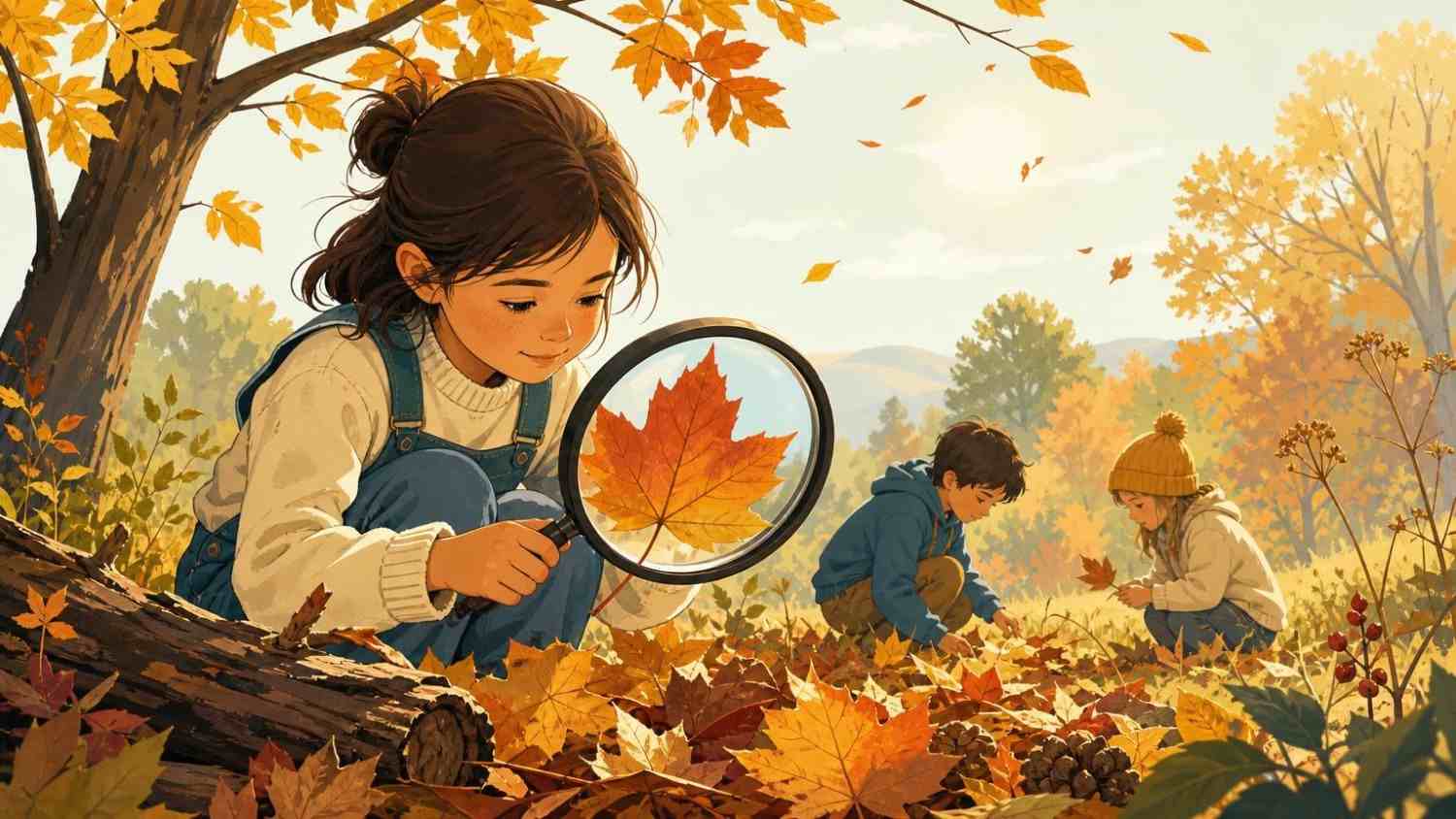
There’s something about the first cool morning of autumn that snaps the world into sharper focus. The air feels different, the light shifts, and suddenly kids who’ve spent months running through sprinklers are stopping to pick up acorns and ask why the leaves are turning red. That instinct to notice, question, and collect is exactly what makes fall one of the richest seasons for childhood learning.
Seasonal changes offer children a front-row seat to biology, physics, math, and emotional development, all without a single worksheet. The shift from summer to autumn is especially powerful because it’s dramatic and multisensory: colors change, temperatures drop, animals behave differently, and the whole rhythm of daily life adjusts. When kids fall into focus on these natural shifts, they’re building connections between what they observe and how the world actually works. This isn’t just nature appreciation for its own sake.
Research from the National Wildlife Federation and child development studies consistently show that outdoor, nature-based learning improves attention spans, reduces stress hormones like cortisol, and strengthens executive function in children ages 3 to 12. Autumn, with its built-in curriculum of transformation, gives parents and educators a season-long opportunity to turn curiosity into genuine understanding. Here’s how that plays out across science, math, emotional growth, and environmental awareness.
The Sensory Science of Autumnal Transitions
Fall is a full-body experience for kids. Unlike summer’s relatively uniform warmth or winter’s monochrome chill, autumn engages nearly every sense simultaneously. The crunch of dry leaves underfoot, the smell of damp earth after a rain, the visual spectacle of a hillside turning from green to gold: these aren’t just pleasant moments. They’re neurological events that wire a child’s brain for deeper learning.
Sensory input is the foundation of cognitive development, especially for children under eight. When a child touches, sees, smells, and hears something new, their brain forms neural pathways that connect that experience to language, memory, and reasoning. Autumn provides a constantly shifting sensory environment, which means those pathways are being built and reinforced week after week as the season progresses.

Visual Stimuli and Color Recognition
The fall color palette is a natural lesson in optics and biology. Young children (ages 2 to 5) can practice identifying and naming colors as leaves transition from green to yellow, orange, red, and brown. But older kids can go deeper: why do leaves change color at all? The answer involves chlorophyll breaking down as daylight hours decrease, revealing pigments like carotenoids (yellows and oranges) and anthocyanins (reds and purples) that were there all along, just hidden.
This is a perfect opportunity to introduce the concept of wavelengths. Green leaves absorb red and blue light and reflect green, which is why we see them as green. As chlorophyll fades, different wavelengths get reflected. A 2024 study from the University of Vermont found that children who learned about color through natural observation retained the information 40% longer than those who learned from diagrams alone. Try giving kids a paint chip strip from a hardware store and having them match the colors to actual leaves. It turns a walk into a scavenger hunt with real science behind it.
Tactile Learning Through Natural Textures
Autumn is a texture goldmine. Smooth acorns, rough bark, papery dried leaves, spongy moss, prickly seed pods: each one activates different tactile receptors in a child’s fingertips. For children under six, this kind of hands-on exploration is how they categorize the physical world. Occupational therapists often recommend nature-based tactile play for sensory processing development, and fall provides the materials for free.
A simple activity: collect ten different natural objects during a walk and have kids sort them by texture with their eyes closed. This builds vocabulary (rough, smooth, bumpy, brittle, soft) while strengthening the connection between touch and language. For kids who struggle with sensory sensitivities, autumn’s gradual changes can also serve as gentle exposure therapy, letting them encounter new textures at their own pace in a low-pressure outdoor setting.
Observing Life Cycles and Biological Shifts
Fall is essentially a live biology lesson. Trees shed leaves, animals change behavior, insects disappear, and the entire ecosystem visibly prepares for winter. For children, watching these shifts in real time teaches them something textbooks struggle to convey: that living systems are dynamic, interconnected, and responsive to their environment.
Deciduous Trees and Photosynthesis Awareness
Most kids learn the word “photosynthesis” at some point, but autumn makes the concept tangible. When a child asks why a tree is losing its leaves, you can explain that the tree is making a strategic decision. Producing leaves costs energy, and during winter’s short days and weak sunlight, the energy return on that investment drops below what the tree can sustain. So the tree cuts its losses, literally, by forming an abscission layer at the base of each leaf stem and letting them fall.
This is compound interest logic applied to biology: the tree is managing resources, investing energy where the return is highest. Kids as young as seven can grasp this concept when you frame it as the tree “deciding” to save energy for spring. You can make it hands-on by tracking a single tree over the course of October and November, photographing it weekly. By the end, kids have a visual timeline of a biological process that took weeks to unfold, something no classroom video can replicate.
Animal Behavior: Migration and Hibernation Patterns
Geese flying in V-formation overhead, squirrels frantically burying acorns, monarch butterflies heading south: fall animal behavior is visible and fascinating. Each of these behaviors is a response to decreasing daylight and dropping temperatures, triggered by hormonal changes in the animals’ endocrine systems.
For younger kids, the concept is straightforward: some animals leave, some sleep, and some stay and adapt. But for kids ages 8 to 12, you can go further. Why do geese fly in a V? Because the lead bird creates an updraft that reduces wind resistance for the birds behind it by up to 65%, according to research from the Royal Veterinary College. The birds rotate the lead position to share the workload. That’s aerodynamics and cooperation in a single observation.
Hibernation is equally rich. A groundhog’s heart rate drops from about 80 beats per minute to as few as 5 during hibernation. Its body temperature can fall to just above freezing. Kids can compare that to their own resting heart rate (typically 70 to 100 bpm for children) and start to understand what metabolic slowdown actually means. Try counting heartbeats together, then imagining what it would feel like to have your heart beat only five times in a minute.
Developing Mathematical Concepts in the Great Outdoors
Math doesn’t have to live on paper. Autumn’s natural materials and measurable changes create opportunities for kids to practice counting, sorting, measuring, and graphing in contexts that actually matter to them. A child who resists math worksheets might happily spend an hour sorting acorns by size or tracking the week’s high temperatures.
Sorting and Classifying Natural Artifacts
Sorting is one of the earliest mathematical skills, and fall provides an endless supply of sortable objects. Leaves can be grouped by color, shape, size, or tree species. Acorns, pinecones, seeds, and stones can be arranged by weight, texture, or symmetry.
Here’s a practical activity that scales with age:
- Ages 3 to 5: Sort leaves into two groups (big and small, or red and yellow). Count how many are in each group.
- Ages 5 to 7: Create a Venn diagram on the ground using sticks. Sort leaves that are red, leaves that are big, and leaves that are both red and big.
- Ages 8 to 12: Collect 50 leaves from different trees. Create a classification key based on multiple attributes (shape, edge type, vein pattern). This mirrors the actual botanical classification process.
The underlying math here is set theory and data organization, concepts that show up in every standardized math curriculum but feel abstract on paper. When a child physically moves objects into groups and compares quantities, they’re building the spatial and logical reasoning that algebra will later require.
Measuring Weather Changes and Temperature Drops
Fall weather is inherently variable, which makes it perfect for measurement activities. A simple outdoor thermometer becomes a math tool when kids record the temperature at the same time each morning and plot it on a graph over several weeks.
By mid-October in most temperate climates, kids will see a clear downward trend. That’s their first encounter with a negative slope, a concept they’ll formally learn in middle school math. You can extend this by having them calculate the average daily temperature for each week, find the range between the highest and lowest readings, or predict next week’s temperature based on the trend they’ve observed.
Weather journals work especially well for this. A child who records temperature, cloud cover, wind speed (estimated), and precipitation daily for six weeks has created a genuine data set. They can answer real questions with it: Was the second week of October warmer than the first? How many days had temperatures below 50°F? What was the coldest morning? This isn’t busywork. It’s the scientific method applied to their own backyard.
Cultivating Emotional Intelligence and Adaptability
Seasonal change isn’t just a science topic. It’s an emotional one. For children, watching the world transform around them raises questions about loss, change, and what comes next. These are big feelings, and autumn provides a safe, natural context for exploring them.
Embracing Change and the Concept of Impermanence
A child watching their favorite climbing tree lose all its leaves is experiencing impermanence in a concrete, non-threatening way. The tree isn’t dying. It’s changing. And it will come back in spring. This cycle of loss and renewal is one of the most important emotional concepts a child can internalize, because it builds resilience.
But here’s what’s actually happening in the brain: when children repeatedly experience predictable cycles of change, their prefrontal cortex develops stronger pattern-recognition capabilities. They learn that change is temporary, that discomfort passes, and that new things emerge after loss. This is the neurological foundation of emotional regulation.
One common mistake parents make is rushing past the sadness a child might feel about summer ending or the days getting shorter. Instead of saying “don’t be sad, fall is fun too,” try acknowledging the feeling: “It sounds like you miss the long summer days. What do you think you’ll miss most?” Then pivot: “What are you looking forward to about fall?” This validates the emotion while teaching the child to hold two feelings at once, a skill psychologists call emotional complexity, which predicts better social relationships and mental health outcomes in adolescence.
You can also use autumn as a metaphor for other transitions: starting a new school year, moving to a new house, or adjusting to a new sibling. Trees don’t resist losing their leaves. They release them and redirect their energy. That’s a powerful image for a child learning to let go of one phase and embrace the next.
Fostering Environmental Stewardship Through Seasonality
Children who spend time observing seasonal changes develop something that environmental educators call “place attachment,” a genuine emotional connection to their local ecosystem. A 2025 study published in the journal Environmental Education Research found that children who regularly engaged with seasonal outdoor activities were 3.2 times more likely to express concern about environmental issues and 2.7 times more likely to take voluntary conservation actions (like picking up litter or conserving water) compared to peers who primarily learned about nature through screens.
This makes intuitive sense. You protect what you love, and you love what you know. A child who has watched “their” oak tree change through four seasons feels ownership of that tree in a way that a child who watched a documentary about forests simply doesn’t. Fall is particularly effective for building this connection because the changes are so visible and so fast. In the span of six to eight weeks, the entire visual character of a neighborhood shifts.
Practical ways to build environmental stewardship through autumn include starting a seasonal nature journal that spans multiple years (so kids can compare this October to last October), participating in local leaf composting programs, building brush piles for overwintering insects and small mammals, and planting spring-blooming bulbs in the fall, which teaches kids about delayed gratification and forward planning in an ecological context.
The goal isn’t to raise tiny activists. It’s to help kids understand that they’re part of a living system, not separate from it. When a child understands why leaves fall, why geese migrate, and why the temperature drops, they understand that nature operates on logic and interdependence. That understanding is the seed of genuine environmental care, and autumn is the season that plants it.
Fall’s gift to childhood learning is its honesty. Nothing is hidden: the changes are right there, visible and touchable and countable. Kids who engage with seasonal shifts don’t just learn facts about chlorophyll or migration patterns. They develop the habits of observation, questioning, and pattern recognition that underpin every kind of learning they’ll do for the rest of their lives. Whether you’re a parent, teacher, or caregiver, the simplest thing you can do this season is slow down, step outside, and let a child lead you to whatever caught their eye. The acorn they pick up might just be the start of something bigger than either of you expects.