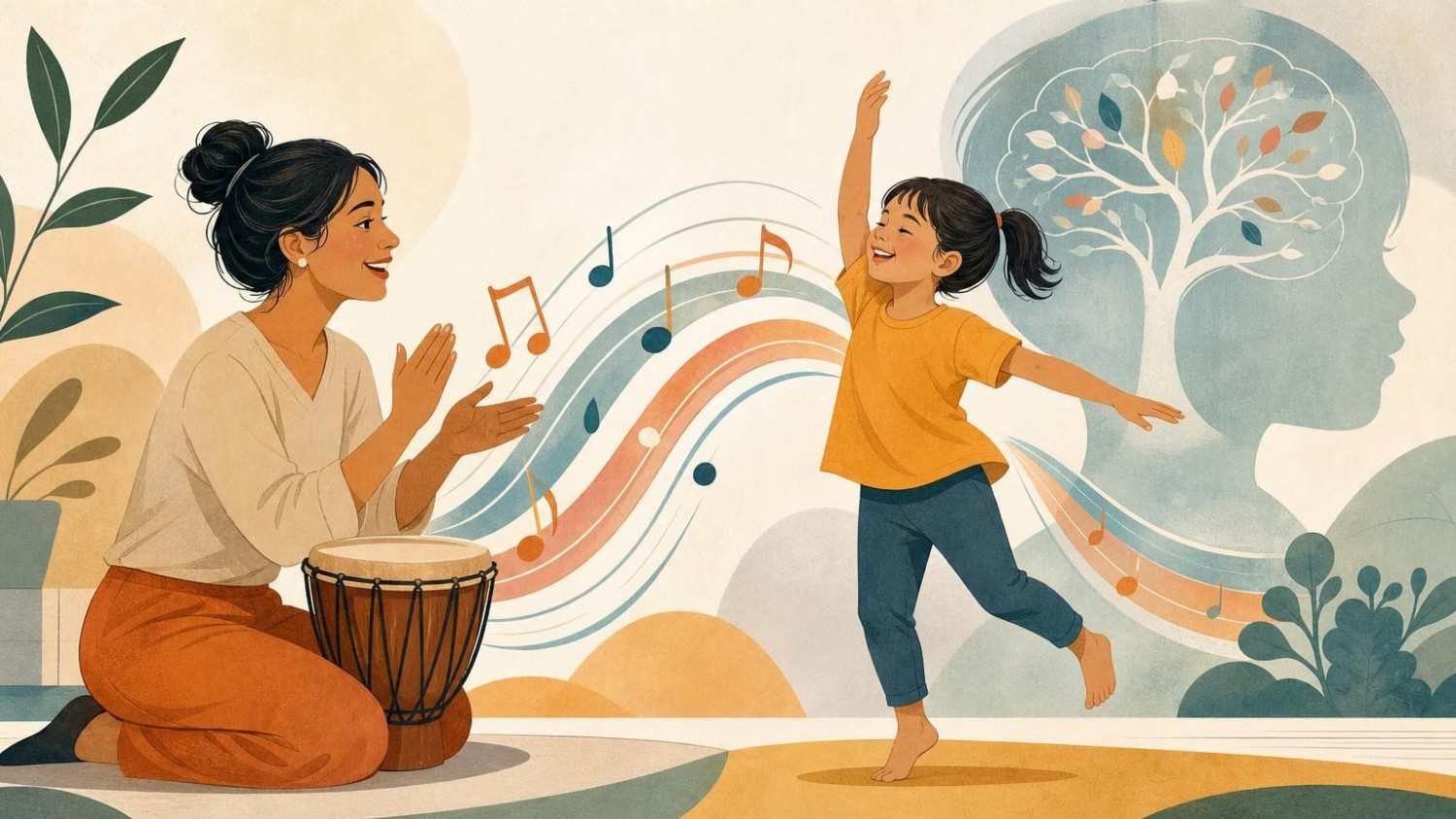
A two-year-old hears a drumbeat and starts stomping her feet before she even understands the word “rhythm.” A four-year-old belts out a nonsense song while spinning in circles, completely absorbed. These moments look like pure play, but underneath the surface, something remarkable is happening: the brain is building connections at a pace it will never match again. The relationship between music, movement, and child development is one of the most well-studied areas in early childhood research, and the findings consistently point in the same direction. Kids who sing, dance, clap, and move to music develop faster across nearly every measurable domain: language, motor skills, emotional regulation, and social awareness.
What makes this pairing so effective isn’t magic. It’s biology. The auditory and motor systems in a young child’s brain are deeply intertwined, and activating both at once creates a richer, more durable learning experience than either one alone. If you’ve ever wondered how music and movement actually boost child development, the short answer is that they engage more of the brain, more often, during the years when the brain is most hungry for input. The longer answer is worth understanding, because it changes how you think about play, education, and what “learning” really looks like for young children.
The Synergy of Auditory and Physical Play in Early Childhood
When a child claps along to a song, two major brain systems fire simultaneously: the auditory cortex processes the sound, while the motor cortex coordinates the physical response. This dual activation isn’t just additive; it’s multiplicative. Research from the Neuroscience and Education Lab at Harvard has consistently shown that multimodal experiences, those engaging more than one sense at a time, create stronger neural pathways than single-channel activities.
Think of it like compound interest for the brain. A child listening to a story gets one layer of input. A child singing a story while acting it out gets three or four layers at once: auditory processing, motor planning, spatial awareness, and emotional engagement. Each layer reinforces the others, and the result is learning that sticks.

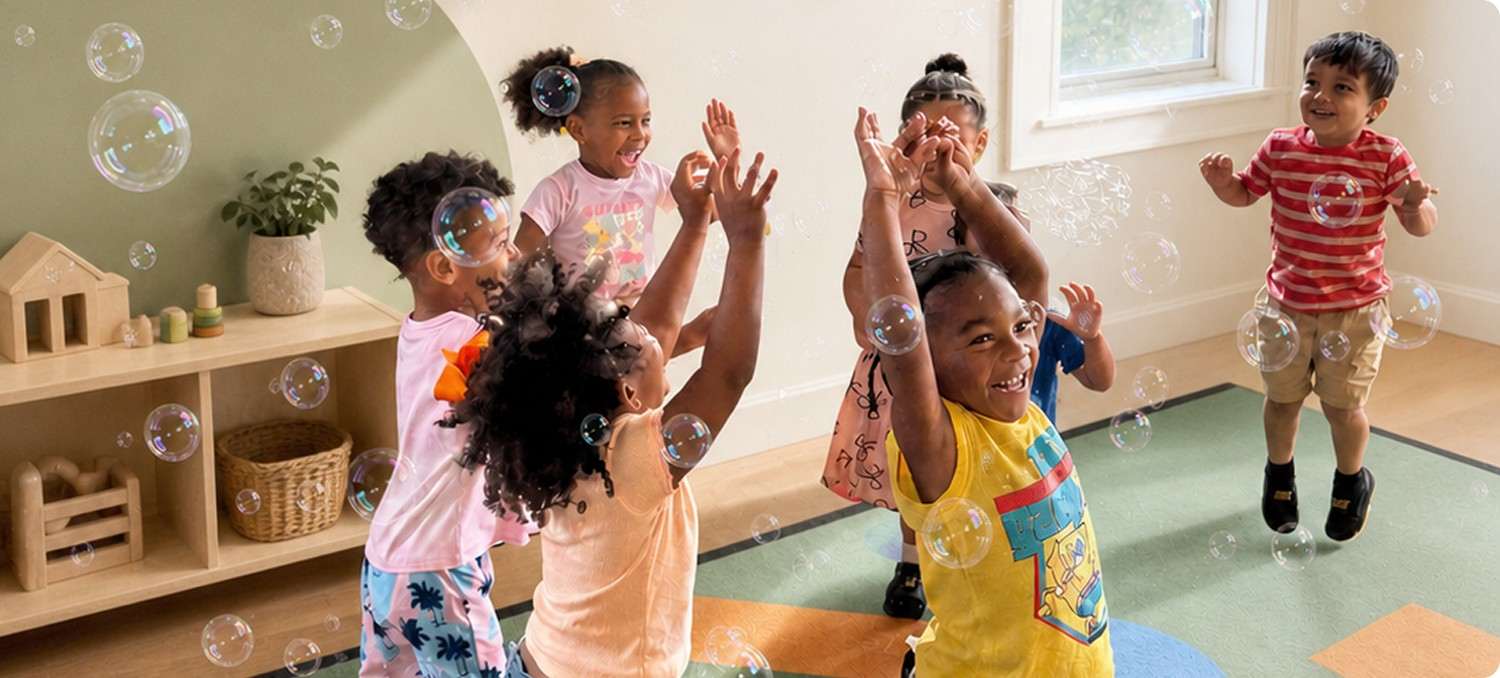
This is why early childhood programs that integrate music and movement report stronger outcomes than those relying on passive instruction alone. A 2024 meta-analysis published in Developmental Science found that children aged two to six who participated in regular music-and-movement activities scored 18% higher on cognitive assessments compared to peers in traditional classroom settings. The effect was most pronounced in working memory and executive function, two skills that predict academic success well into adolescence.
The practical takeaway here is simple: the more senses you engage during a learning activity, the more the developing brain benefits. And few activities engage as many senses as naturally as music paired with physical play.
Cognitive Growth and Brain Plasticity
The first six years of life represent a window of extraordinary brain plasticity. During this period, the brain forms roughly 700 new neural connections per second. Music and rhythmic movement are uniquely positioned to shape this process because they require the brain to process timing, pitch, pattern, and coordination all at once, a cognitive workout that few other activities match.
Enhancing Language Acquisition and Phonological Awareness
Here’s what’s actually happening when a toddler sings “Twinkle, Twinkle, Little Star” for the hundredth time: she’s training her brain to detect the building blocks of language. Songs break words into syllables and emphasize phonemes in ways that normal speech doesn’t. The melody acts as a scaffold, making it easier for the brain to isolate individual sounds and map them to meaning.
Phonological awareness, the ability to hear and manipulate the sounds within words, is the single strongest predictor of reading success. Children who can clap out syllables, rhyme words, and identify beginning sounds learn to read faster and with fewer difficulties. Music delivers all of this naturally. A 2025 study from the University of Southern California’s Brain and Creativity Institute found that children with just one year of consistent musical exposure showed measurably thicker auditory cortexes and faster processing of speech sounds compared to a control group.
One common mistake parents make is assuming that “educational” apps or videos provide the same benefit. They don’t. The active, embodied nature of singing and moving is what drives the neural changes. Passive listening helps, but it’s not in the same category.
Strengthening Memory and Pattern Recognition
Music is essentially organized patterns: verse, chorus, verse. Rhythm follows predictable cycles. Melodies repeat and vary in structured ways. For a young brain, this is pattern-recognition training disguised as fun.
Working memory, the ability to hold and manipulate information in your mind, gets a direct workout every time a child learns a new song. She has to remember the words, the melody, the sequence, and often the accompanying movements. That’s a four-part memory task wrapped in something that feels like play.
Research from the Institute of Education at University College London (2025) demonstrated that preschoolers who engaged in structured musical games three times per week for six months showed a 22% improvement in pattern-recognition tasks compared to a matched control group. These gains transferred to early math skills, particularly sequencing and basic arithmetic, suggesting that the cognitive benefits of musical play extend well beyond the music itself.
Building Motor Skills Through Rhythmic Activities
Physical development in early childhood follows a predictable sequence: large movements come first, fine movements follow. Music and rhythm support both stages because they give children a reason to move with intention and precision.
Gross Motor Development and Coordination
Marching to a beat, jumping during a song’s chorus, spinning with arms outstretched: these aren’t random movements. They require the brain to coordinate bilateral movement (using both sides of the body), maintain balance, and adjust timing to an external cue. That’s a sophisticated motor planning task for a three-year-old.
Gross motor coordination built through rhythmic activities translates directly to everyday physical competence. Children who can march in time tend to have better balance. Kids who practice dance movements develop stronger core stability. A 2024 longitudinal study from the Australian Institute of Family Studies tracked 1,200 children over three years and found that those who participated in weekly music-and-movement classes showed significantly better coordination and spatial awareness by age five than peers who did not.
The mechanism makes sense when you think about it: rhythm provides a temporal framework for movement. Instead of moving randomly, the child learns to move in time, which requires planning, anticipation, and adjustment. These are the same skills that later support handwriting, sports, and even safe playground navigation.
Fine Motor Control and Instrument Play
Shaking a maraca, tapping a xylophone, pressing piano keys, strumming a ukulele: each of these activities demands precise finger and hand movements. For children aged three to six, instrument play is one of the most effective ways to develop fine motor control because it combines motivation (making music is inherently rewarding) with repetition (kids will play the same instrument for extended periods without getting bored).
Fine motor development through instrument play also strengthens hand-eye coordination and the pincer grasp, both of which are prerequisites for writing. Instead of drilling a reluctant four-year-old on pencil grip exercises, try handing her a small drum and two mallets. She’ll develop many of the same muscles while actually enjoying herself.
Simple percussion instruments are ideal for younger children. By age four or five, many kids can begin exploring pitched instruments like xylophones or keyboards, which add the cognitive layer of pitch discrimination to the motor task.
Social and Emotional Intelligence
Music is inherently social. Singing together, dancing in a group, taking turns with instruments: these activities create a natural laboratory for emotional and social learning.
Self-Regulation and Stress Reduction
Self-regulation, the ability to manage emotions, control impulses, and adapt behavior to context, is one of the most critical skills a child develops between ages two and six. It’s also one of the hardest to teach directly. You can’t lecture a three-year-old into calming down.
But you can sing. Music activates the parasympathetic nervous system, lowering cortisol levels and heart rate. Slow, rhythmic songs have a measurable calming effect on young children, which is why lullabies exist in virtually every culture on earth. Beyond passive calming, active musical play teaches children to start and stop on cue (think “Freeze Dance”), to modulate their volume and energy, and to transition between emotional states. These are self-regulation skills practiced in a context that feels safe and enjoyable.
A 2025 report from the American Academy of Pediatrics noted that preschool programs incorporating daily music-based regulation activities saw a 30% reduction in behavioral incidents compared to programs without them. That’s not a small effect.
Collaboration and Peer Bonding in Group Settings
Group music-making requires something that’s genuinely hard for young children: paying attention to what other people are doing and adjusting your own behavior accordingly. When four kids are playing rhythm instruments together, each one has to listen, wait, and contribute at the right moment. That’s collaboration in its most basic and most authentic form.
Shared musical experiences also create a sense of belonging. Singing the same song together, moving in unison, or creating a group rhythm generates what psychologists call “interpersonal synchrony,” a feeling of connection that strengthens social bonds. Studies on interpersonal synchrony in children (Sebastian Kirschner, Max Planck Institute) have shown that kids who make music together are more likely to help each other, share resources, and cooperate on subsequent tasks.
Instead of forcing structured “sharing exercises,” try putting three kids around a drum circle. The social learning happens organically.
Creative Expression and Self-Confidence
Creativity isn’t a luxury skill; it’s a cognitive capacity that supports problem-solving, flexible thinking, and resilience. Music and movement give children a low-stakes arena to experiment, improvise, and express themselves without the pressure of “getting it right.”
When a child invents a dance to a song, she’s making dozens of creative decisions: which movements to use, how fast to go, whether to repeat or vary a pattern. When a child makes up lyrics or bangs out a rhythm on a pot with a wooden spoon, he’s composing, even if it sounds like chaos to adult ears.
This kind of open-ended creative play builds self-confidence because there’s no wrong answer. A child who feels free to express herself through movement and music develops a sense of agency: the belief that her ideas matter and her contributions have value. That belief, internalized early, becomes the foundation for academic risk-taking, social assertiveness, and emotional resilience later in life.
One practical note: resist the urge to correct or direct too much. If a child is dancing “wrong” or singing off-key, that’s fine. The developmental value comes from the process, not the performance.
Practical Strategies for Integrating Music and Movement at Home
You don’t need a music degree or a room full of instruments to make this work. The most effective musical play is simple, consistent, and responsive to your child’s interests.
Age-Appropriate Songs and Rhythms
- Birth to 12 months: Lullabies, gentle bouncing on your knee, simple clapping games. Babies respond strongly to rhythm and repetition. Singing the same three songs daily is more beneficial than cycling through dozens.
- 12 to 24 months: Action songs like “Head, Shoulders, Knees, and Toes” or “If You’re Happy and You Know It.” These pair specific movements with words, building vocabulary and motor coordination simultaneously.
- 2 to 4 years: Call-and-response songs, freeze dance, marching games, and simple percussion play. This is the age where group musical activities become especially powerful.
- 4 to 6 years: Introduce pitched instruments, more complex songs with multiple verses, and creative movement challenges (“Move like a snake,” “Dance like it’s raining”). Children this age can begin to follow simple musical structures and even compose short melodies.
Creating a Sensory-Rich Environment
You don’t need expensive equipment. A sensory-rich musical environment can be assembled from what you already have:
- Fill containers with rice, beans, or beads for homemade shakers
- Use pots, pans, and wooden spoons as a drum kit
- Keep a small basket of simple instruments (egg shakers, tambourines, a triangle) accessible at child height
- Play varied genres of music during daily routines: classical during breakfast, folk during cleanup, upbeat pop during playtime
- Create a “dance space” by clearing a small area of furniture and adding scarves or ribbons for movement play
The key is accessibility. If instruments and music are part of the everyday environment rather than reserved for special occasions, children engage with them more frequently and more naturally. Aim for at least 15 to 20 minutes of active musical play daily, though even five minutes of singing in the car counts.
Fostering a Lifelong Foundation for Learning
The benefits of early musical and movement experiences don’t expire at kindergarten. Children who develop strong auditory processing, motor coordination, emotional regulation, and creative confidence through music carry those capacities into every subsequent learning environment. They become better readers, more flexible thinkers, and more socially attuned classmates, not because music is a shortcut, but because it builds the underlying architecture that all other learning depends on.
Think of early musical play as a preventative investment in your child’s cognitive and emotional infrastructure. The returns show up years later in ways that are hard to trace back to their origin, but the research is clear: they’re real, they’re measurable, and they’re significant.
If you take one thing from this, let it be this: the next time your child bangs on a pot, sings an invented song at full volume, or insists on dancing in the grocery store, don’t shush them. Join in. What looks like noise and chaos is actually a brain under construction, building itself one beat at a time. The simplest, most joyful activities you can share with your child, singing, dancing, clapping, and playing, are also among the most powerful developmental tools available. No app, curriculum, or expensive toy comes close.