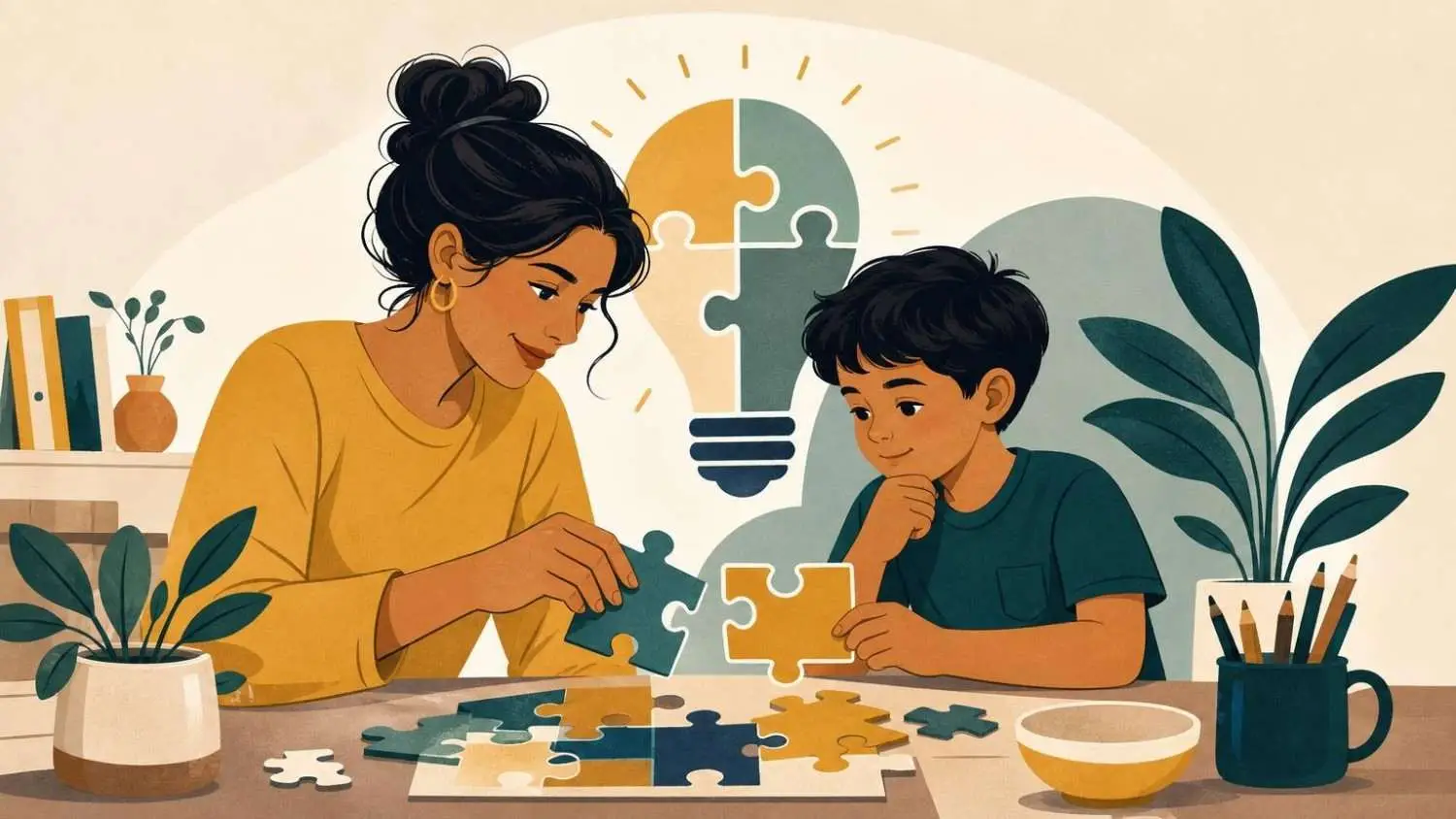
A four-year-old stares at a puzzle piece, turning it sideways, flipping it upside down, and then quietly sliding it into place with a grin. That small moment contains everything: trial, error, spatial reasoning, persistence, and the dopamine hit of figuring something out independently. Most parents assume problem-solving is something kids learn in school, through worksheets or structured STEM programs. But the truth is that the richest opportunities for developing these skills happen during the ordinary hours of a regular day: folding towels, splitting a snack, arguing over who gets the red crayon.
Building problem-solving skills through everyday activities with kids doesn’t require a curriculum or expensive toys. It requires attention, patience, and a willingness to let your child struggle just enough to grow. The research on this is clear and surprisingly consistent. Children who regularly practice solving small, real-world problems before age seven show stronger academic performance and emotional regulation well into adolescence. The trick isn’t adding more structured activities to an already packed schedule. It’s recognizing the learning potential in what you’re already doing, and then getting out of the way just enough to let your child’s brain do the work.
The Psychology of Early Problem-Solving Development
The prefrontal cortex, the brain region responsible for planning, reasoning, and impulse control, doesn’t fully mature until the mid-twenties. But its most dramatic period of growth occurs between ages three and seven. During this window, neural connections are forming at a staggering rate: roughly 700 to 1,000 new synaptic connections per second, according to research from Harvard’s Center on the Developing Child. Every time a young child encounters a problem, works through frustration, and arrives at a solution, those neural pathways get reinforced.
This isn’t random. The mechanism makes sense when you think about it as compound interest for the brain. Small, repeated problem-solving experiences compound over time into stronger cognitive architecture. A child who figures out how to stack blocks so they don’t topple is literally building the same neural circuits they’ll later use for algebra, essay writing, and conflict resolution.

Fostering a Growth Mindset Through Failure
Stanford psychologist Carol Dweck’s work on growth mindset has been widely cited, but the practical application in early childhood is often misunderstood. The goal isn’t to tell kids “you can do anything.” It’s to help them see failure as information rather than identity.
One common mistake is rushing in to fix things when a child gets frustrated. Instead of saying “here, let me do it,” try “what part is tricky?” This small shift keeps the child in the driver’s seat. A 2024 study from the University of Cambridge found that children whose parents used question-based responses during moments of frustration showed 34% higher persistence on difficult tasks six months later compared to children whose parents provided immediate solutions.
The key is calibrating the difficulty. Psychologists call this the “zone of proximal development,” a concept from Lev Vygotsky. You want challenges that are hard enough to require effort but not so hard that the child shuts down entirely. Think of it as setting the thermostat for productive struggle.
Executive Function and Decision-Making Skills
Executive function is the brain’s air traffic control system: it manages working memory, flexible thinking, and self-control. These three capacities underpin every problem-solving task a child will face. Research from the University of Minnesota has shown that executive function skills at age five are a better predictor of academic success than IQ.
Daily life offers constant opportunities to exercise these skills. Asking a child to remember three items from the grocery list works their working memory. Letting them choose between two different routes to the park exercises flexible thinking. Waiting their turn for a swing builds inhibitory control.
The neurobiological basis here is straightforward. Each time a child practices these skills, myelin, the fatty sheath around nerve fibers, thickens on the relevant neural pathways. Thicker myelin means faster signal transmission. Faster signals mean more efficient problem-solving. It’s physical brain construction happening in real time.
Transforming Household Chores into Logical Challenges
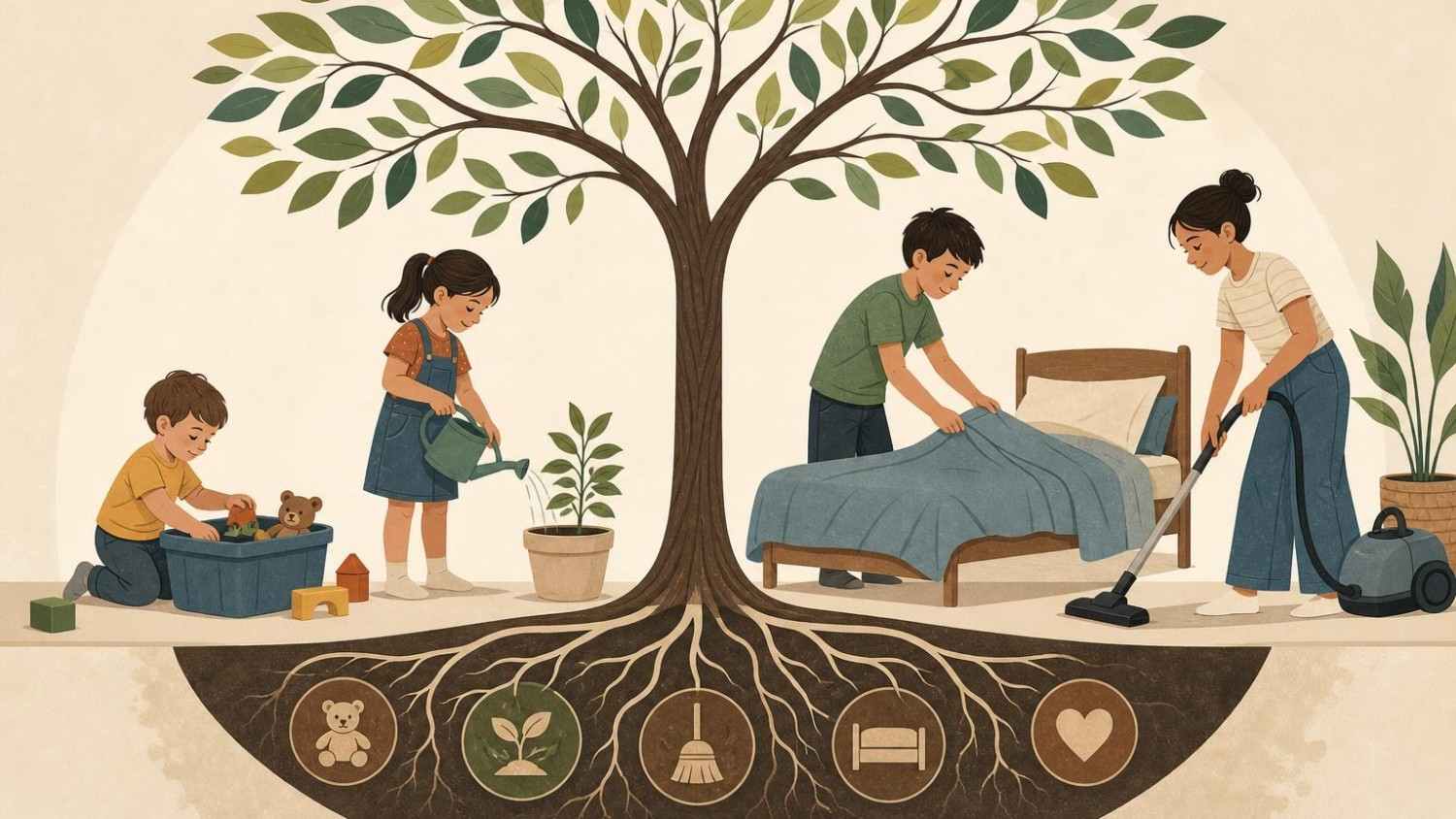
Chores are universally unpopular with kids, but they’re also one of the most underrated problem-solving training grounds available. The structure of most household tasks, a clear goal, limited resources, and a defined outcome, mirrors the structure of formal logic problems. The difference is that a five-year-old doesn’t realize they’re doing logic when they’re sorting silverware.
A 2023 study published in the Journal of Applied Developmental Psychology found that children who participated in regular household tasks showed measurably stronger planning and sequencing abilities by age eight. The effect was strongest when children were given ownership of the task rather than simply following step-by-step instructions.
Sorting and Categorizing During Laundry or Cleanup
Sorting laundry is a classification exercise in disguise. Ask a three-year-old to separate whites from colors and you’ve introduced binary categorization. Ask a five-year-old to sort by owner, color, and garment type and you’ve introduced multi-variable classification, which is the same cognitive skill used in scientific taxonomy.
Try this: dump a basket of clean laundry on the floor and ask your child to figure out the fastest way to sort it. Don’t give them a method. Watch what system they invent. Some kids sort by person first, then fold. Others sort by garment type. The method matters less than the fact that they’re creating and testing a system.
Cleanup time works the same way. Instead of directing where every toy goes, ask: “How should we organize these so we can find them tomorrow?” You’ll be surprised by the logic kids apply when given the chance.
Meal Planning and Kitchen Measurement Math
The kitchen is basically a science lab with better snacks. Measuring ingredients introduces fractions in a tangible, sensory way. A child who pours half a cup of flour three times and watches it fill a cup-and-a-half understands multiplication on a physical level before they ever see a times table.
Meal planning adds another layer. Give a six-year-old the constraint of planning a dinner with one protein, one vegetable, and one starch, and they’re practicing constraint-based problem-solving. Add a budget (“we have $15 for dinner ingredients”) and you’ve introduced resource allocation.
One approach that works well: let kids plan one meal per week. They pick the recipe, help make the grocery list, and assist with preparation. The cognitive demands here are significant: sequencing steps, estimating time, adjusting quantities, and troubleshooting when something goes wrong. That’s project management for the under-ten set.
Navigating Social Conflicts and Emotional Regulation
Here’s what’s actually happening when two kids fight over a toy: they’re encountering a resource allocation problem with emotional variables. The cognitive demand of resolving a social conflict is enormous. A child has to identify the problem, consider another person’s perspective, generate possible solutions, evaluate outcomes, and manage their own emotional state, all simultaneously.
Research from Yale’s Center for Emotional Intelligence shows that children who develop strong conflict resolution skills by age six are 40% less likely to experience behavioral problems in elementary school. These aren’t soft skills. They’re core problem-solving competencies wrapped in social packaging.
Mediation Techniques for Sibling Rivalry
Instead of playing judge and jury when siblings clash, try acting as a mediator. The difference is crucial. A judge hands down a verdict. A mediator helps both parties find their own solution.
A simple framework that works for kids as young as four:
- Each child states what happened from their perspective, without interruption
- Each child names how they feel using specific emotion words
- Both children brainstorm at least two possible solutions
- They agree on one to try
This isn’t random conflict resolution theory. It mirrors the formal mediation process used in adult dispute resolution, scaled down for developing brains. The repeated practice of generating multiple solutions is particularly valuable. Research from Vanderbilt University has found that children who can generate three or more solutions to a social problem show significantly better peer relationships than those who can only think of one.
Role-Playing Common Social Dilemmas
Role-playing lets kids practice problem-solving in low-stakes scenarios before they face real ones. Think of it as a flight simulator for social situations. You can set up scenarios like: “Your friend wants to play tag, but you want to draw. What could you say?”
The power of role-playing is that it activates the same neural networks as real experience. Mirror neurons fire whether a child is experiencing a situation or imagining it vividly. This means rehearsed solutions become more accessible during actual conflicts.
Try reversing roles so your child plays the other person. Perspective-taking is one of the most cognitively demanding tasks for young children, and it directly strengthens the prefrontal circuits responsible for flexible thinking. A child who can genuinely imagine another person’s viewpoint has a massive advantage in every problem-solving context they’ll encounter.
Outdoor Exploration and Physical Obstacles
Physical problem-solving, figuring out how to climb a rock, cross a stream, or build something that stands up, engages the brain differently than purely cognitive tasks. It recruits the cerebellum and motor cortex alongside the prefrontal cortex, creating richer and more durable neural connections.
A 2025 meta-analysis in the journal Developmental Science found that children who spent at least 45 minutes daily in unstructured outdoor play scored 27% higher on standardized problem-solving assessments than peers with primarily indoor, structured activities. The unstructured element is key. Playgrounds with predetermined paths and fixed equipment offer less problem-solving opportunity than a patch of woods with fallen logs and muddy streams.
Nature-Based Scavenger Hunts and Map Reading
Scavenger hunts are problem-solving gold because they combine observation, categorization, and spatial reasoning. But skip the pre-printed lists from Pinterest. Instead, create challenges that require interpretation: “Find something that was alive last year but isn’t now” or “Find three things that are the same color but different textures.”
Map reading, even with simple hand-drawn maps, introduces spatial reasoning and symbolic thinking. A child who can translate a bird’s-eye-view drawing into a walking route is performing a sophisticated cognitive operation. Start with maps of your backyard or a local park. Let the child orient the map, identify landmarks, and navigate to a destination.
For older kids (seven and up), try giving them a compass and teaching basic orienteering. The combination of tool use, spatial reasoning, and physical navigation creates a problem-solving experience that no screen-based activity can replicate.
Building Forts and Structural Experimentation
Fort building is engineering without the textbook. When a child tries to drape a blanket over chairs and it keeps sliding off, they’re encountering structural engineering problems: load distribution, anchor points, tension versus compression. They don’t need those terms. They need the experience of trying, failing, and adjusting.
Provide raw materials rather than kits. Cardboard boxes, sticks, rope, old sheets, and clothespins offer more problem-solving potential than any pre-designed building set. The lack of instructions is the point. A child working with undefined materials has to imagine a structure, plan construction steps, test their approach, and iterate when it fails.
One approach: challenge your child to build a fort that can withstand a specific test, like holding up a stuffed animal or surviving a fan blowing on it. Defined success criteria give kids a concrete goal to problem-solve toward while leaving the method entirely open.
Encouraging Independent Thinking Through Open-Ended Play
Structured activities have their place, but open-ended play is where the deepest problem-solving happens. Developmental psychologist Laura Berk at Illinois State University spent decades studying private speech, the muttering kids do while playing alone, and found that it serves as a crucial self-regulation and planning tool. Children engaged in open-ended play produce significantly more private speech, which correlates with stronger executive function development.
The parental instinct to organize, direct, and optimize children’s play is understandable but counterproductive. Every time you tell a child what to build or how to play, you remove a problem-solving opportunity. The goal is to be available but not directive: present but not in charge.
The Power of ‘What If’ and ‘How’ Questions
The questions you ask shape how your child thinks. Closed questions (“Is that a dog?”) produce yes-or-no answers. Open questions (“What do you think would happen if we mixed these two colors?”) produce hypotheses, predictions, and reasoning.
Instead of asking “What color is that?”, try “How did you decide to use that color?” Instead of “Did you have fun?”, try “What was the hardest part?” These questions push children beyond recall into analysis and reflection.
A practical habit: aim for a 3:1 ratio of open to closed questions during play. You don’t need to track this precisely, but the awareness alone shifts your questioning patterns. Over weeks, you’ll notice your child starting to ask more complex questions themselves, a sign that their thinking is becoming more sophisticated.
Utilizing Loose Parts and Recycled Materials
The “loose parts” theory, originally proposed by architect Simon Nicholson in 1971, argues that environments with movable, combinable materials generate more creativity and problem-solving than fixed environments. Fifty-five years later, the research continues to support this.
Stock a bin with bottle caps, cardboard tubes, fabric scraps, buttons, string, and popsicle sticks. Don’t label it or provide instructions. Just make it available. Children will invent games, build contraptions, create art, and solve problems you never anticipated.
The recycled materials angle matters for another reason: it teaches resourcefulness. A child who learns to see a toilet paper roll as a potential telescope, bridge support, or marble run component is developing divergent thinking, the ability to generate multiple uses for a single object. This is the same cognitive skill that drives innovation in every field.
Integrating Critical Thinking into Daily Routines
The most effective way to help kids develop problem-solving skills isn’t through special activities or dedicated “learning time.” It’s through consistent, small adjustments to routines you’re already doing. Breakfast, bedtime, car rides, and errands all contain dozens of micro-opportunities for critical thinking.
During grocery shopping, ask your child to estimate whether the items in the cart will cost more or less than $50. On car rides, pose “would you rather” questions with real trade-offs: “Would you rather have a pet that lives 20 years but you can’t travel, or a pet that lives 5 years and you can go anywhere?” These aren’t trick questions. They’re exercises in weighing competing values, which is the essence of critical thinking.
Track your child’s progress informally. Notice whether they’re generating more solutions to problems on their own, whether their frustration tolerance is increasing, whether they’re asking more complex questions. These are better indicators of growing problem-solving ability than any test score.
The whole point of developing problem-solving skills through everyday moments with kids is that it becomes invisible: woven into the fabric of daily life rather than bolted on as an extra obligation. Children who grow up in homes where thinking is valued, where struggle is expected, and where questions outnumber answers develop a relationship with problems that serves them for decades. They see a challenge and lean in rather than shut down. That’s not something you can teach in a single lesson. It’s something you build, one sorted sock and one “what if” question at a time.