
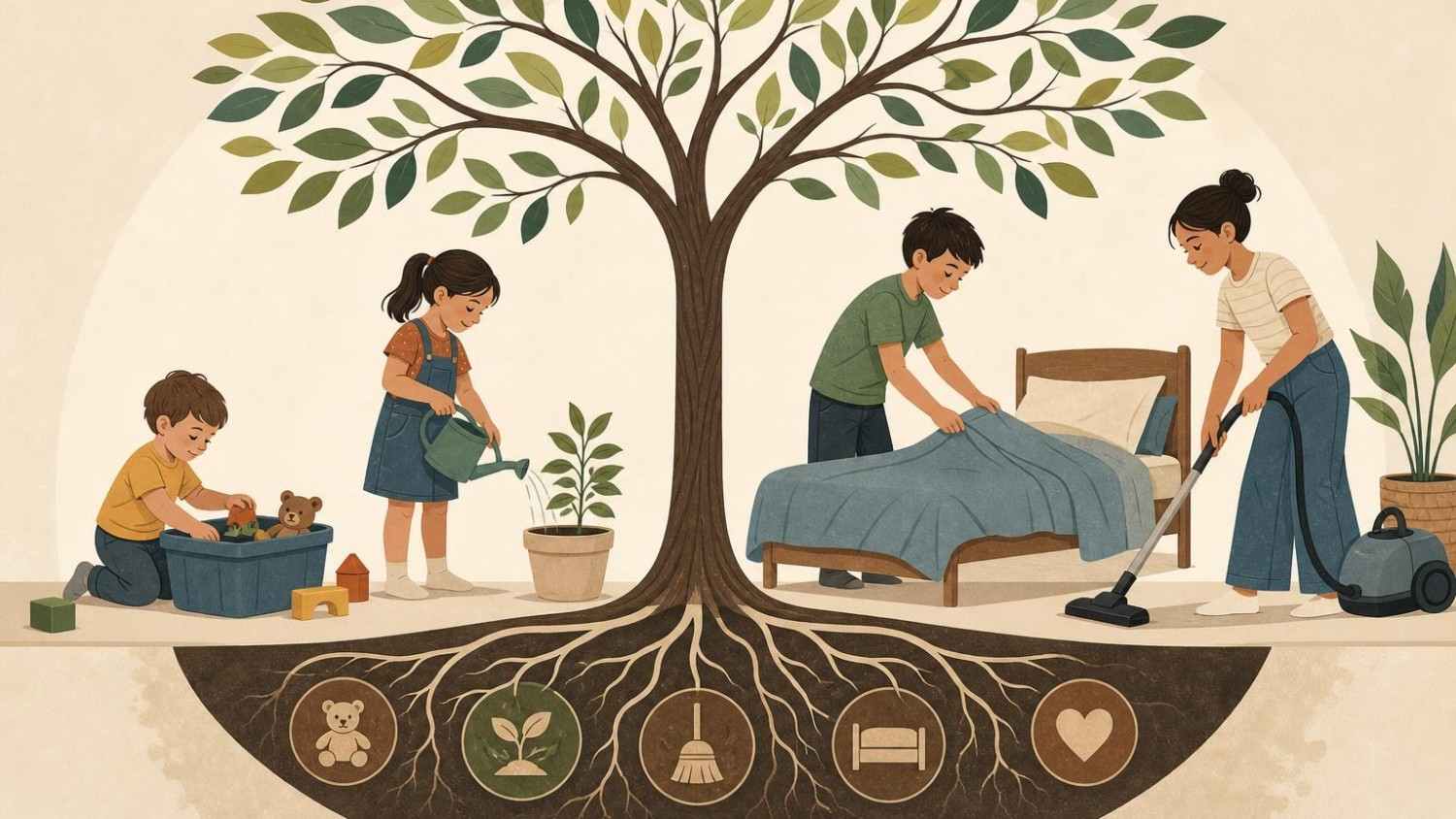
Every parent knows the scene: you ask for help clearing the table, and suddenly your child develops a mysterious limp, an urgent homework crisis, or a sudden interest in the dog. It’s tempting to just do it yourself. It’s faster, cleaner, and nobody whines.
But doing everything for your kids quietly teaches them that the house runs on magic. Somebody else handles the dishes, the laundry, and the overflowing trash, and they never have to think about it. The good news is that the fix doesn’t require a color-coded spreadsheet or a weekly family meeting with minutes. It requires matching the right job to the right age, staying consistent, and tolerating some lopsided towel folding for a while.
This guide walks through chores for kids by developmental stage, from toddlers stacking blocks to teenagers cooking dinner, along with how to handle resistance, whether to pay, and which tools stay off-limits. The goal isn’t a spotless house. It’s a kid who grows into an adult who knows how to take care of a home and the people in it.
The Psychology of Responsibility and Household Contribution
Here’s something that surprises a lot of parents: toddlers genuinely want to help. Watch a two-year-old grab a broom twice their height or insist on “carrying” a grocery bag with one apple in it. That urge to participate is real, and it’s one of the most useful instincts you’ll ever get to work with.
Here’s what’s actually happening. Young children build their sense of identity partly through contribution. When a child helps and sees that it matters, they start forming a self-concept along the lines of “I’m someone who pitches in.” Developmental psychologists often describe this as moving from external rules (“Mom says I have to”) to internal values (“This is what our family does”).
The trouble starts when parents, understandably, turn away that early help because it slows things down. A four-year-old who hears “No, let me do it” twenty times learns that their contribution isn’t wanted. By age eight, when you actually need help, the instinct has faded and chores feel like punishment.
Think of household responsibility like compound interest. Small deposits made early, such as wiping a spill or putting shoes by the door, grow into habits that pay off for decades. Wait until a child is twelve to start, and you’re making large withdrawals from patience on both sides just to catch up.


Toddlers and Preschoolers: Building Basic Motor Skills
At this stage, chores are really motor-skill practice in disguise. Grasping, carrying, sorting, and matching all build the coordination kids need for later tasks. Your job is to keep the bar low, the instructions short, and the praise specific.
Ages 2 to 3: Simple Pick-Up Tasks
Two- and three-year-olds do best with one-step tasks they can finish in under two minutes. Good options include:
- Toys into bins: Use open baskets rather than lidded boxes, and add picture labels.
- Dirty clothes into the hamper: Make it a game by “shooting baskets.”
- Wiping small spills: Keep a damp cloth at their height.
- Feeding a pet: You measure the food, they pour it into the bowl.
- Carrying light items: Napkins to the table, a plastic cup to the sink.
One common mistake is expecting a toddler to “clean your room.” That’s a vague, overwhelming request. “Put the cars in the red bin” is a task they can actually complete.
Ages 4 to 5: Following Multi-Step Directions
Preschoolers can handle two or three steps in sequence, which opens up a lot more. A five-year-old can set the table if you show them where forks and plates go, and some families tape a simple placemat diagram to the counter as a reference.
Other good fits include making the bed (pulling up the comforter counts), sorting socks by color, watering plants with a small can, and helping unload utensils from the dishwasher, minus sharp knives. Expect mismatched socks and a lumpy duvet. If the bed looks like a small animal is sleeping under it, the job is still done, and redoing it in front of them teaches that their effort doesn’t count.
Elementary Schoolers: Developing Consistency and Routine
The elementary years shift the focus from “can they do it?” to “will they do it without being asked?” Skills are mostly there. Consistency is what you’re building now.
Ages 6 to 8: Personal and Shared Spaces
Kids in this range can take real ownership of their own space and start contributing to shared areas. A reasonable load is two or three daily tasks plus one weekly job.
Daily ideas include making their bed, packing their own school bag, clearing their plate, and putting clean laundry away. Weekly jobs might be dusting baseboards, sweeping the porch, matching socks for the whole family, or helping put groceries away.
This is also the age to introduce shared-space responsibility. A seven-year-old who wipes down the bathroom sink every Saturday starts to understand that common areas don’t clean themselves. The mechanism makes sense when you think about it: kids care more about spaces they help maintain.
Ages 9 to 11: Managing Complex Chores Independently
By nine or ten, many kids can run an entire chore start to finish with minimal supervision. That means:
- Doing a full load of laundry: sorting, washing, drying, and folding.
- Loading and running the dishwasher.
- Vacuuming a room, including moving light furniture.
- Taking out trash and recycling on collection day.
- Making simple meals: sandwiches, scrambled eggs with supervision, or a basic salad.
- Cleaning a bathroom: toilet, tub, and mirror with kid-safe products.
The shift here is from task to system. Instead of “fold these towels,” it becomes “you’re in charge of towels this week.” A child who notices the towel bin is full and handles it without a reminder has learned something no worksheet can teach.
Middle and High Schoolers: Preparing for Independent Living
Teenagers are, functionally, adults in training. The question for this stage is simple: if your kid moved out tomorrow, what would they not know how to do? Start there.
Core skills worth covering before eighteen include planning and cooking several full meals, grocery shopping on a budget, cleaning a kitchen properly (including the fridge and stovetop), doing their own laundry with attention to care labels, basic yard work, changing bedsheets, and handling small repairs like unclogging a drain or replacing a light bulb fixture cover.
A practical approach many families use: once a week, a teen plans and cooks dinner for the household. They pick the recipe, write the shopping list, stay within a set grocery amount, and clean up afterward. It covers budgeting, time management, cooking, and cleanup in one go.
Teens push back hard if chores feel arbitrary, so explain the why. “You’ll need this at college” lands better than “because I said so.” Give them more autonomy over when chores get done, as long as they get done by an agreed deadline. A sixteen-year-old who vacuums at 9 p.m. on Sunday has still vacuumed.
Strategies for Motivation and Overcoming Resistance
Every kid resists chores at some point. That isn’t a sign your system failed. It’s a sign your kid is normal.
A few approaches that tend to work better than nagging:
- Use “when-then” framing: “When the dishwasher is unloaded, then we’ll go to the park.” It’s matter-of-fact, not a threat.
- Work alongside younger kids: A six-year-old cleaning their room alone feels exiled. Cleaning while you fold laundry in the doorway feels like teamwork.
- Offer choices within limits: “Do you want to vacuum or dust today?” Kids comply more readily when they had a say.
- Praise effort specifically: “You got every crumb off that counter” means more than “good job.”
- Let natural consequences happen: If a teen doesn’t wash their soccer uniform, they wear it dirty. One smelly practice teaches faster than ten reminders.
One common misconception is that resistance means a chore is too hard. More often it’s boredom or a power struggle. Set a timer and race it, play music, or rotate jobs so nobody is stuck scrubbing toilets forever.
The Debate: To Pay or Not to Pay for Chores
Parents split sharply on this one, and both sides have a point. Paying for chores teaches that work earns money, which is a real-world lesson. The risk is that kids start treating every task as a transaction: “How much will you pay me to take out the trash?”
A middle path many families settle on works well. Baseline chores, like making your bed, clearing your plate, and keeping your room livable, are unpaid because that’s what it means to live in a household. Extra jobs beyond the baseline, such as washing the car, raking the whole yard, or organizing the garage, can earn money.
This keeps family contribution separate from paid work. It also gives kids a way to earn spending money while learning some things you simply do because you’re part of the team.
Creating a Sustainable Family Chore System
The best chore system is the one you’ll actually stick with in week twelve, not the elaborate one you abandon in week two. Keep it minimal. Three or four core daily tasks per child, done consistently, beat a fifteen-item chart nobody looks at.
A simple setup that holds up over time:
- Pick core chores per child, based on the age guidelines above.
- Make it visible: a whiteboard on the fridge, a magnetic chart, or a free family app.
- Anchor chores to existing routines: bed made before breakfast, backpack packed after dinner. Linking to routines removes daily negotiation.
- Rotate shared jobs monthly so no one gets stuck with the worst task.
- Revisit every three months and bump up difficulty as skills grow.
Tracking progress helps you see whether the system is working instead of guessing. Useful metrics include the number of reminders needed per day (aim for this to drop over time), the percentage of chores completed without prompting each week, and how long tasks take. A ten-year-old whose laundry routine drops from forty-five minutes of grumbling to fifteen minutes of quiet work is clearly building the habit. You can also jot down which chores your child now does without being asked at all, which is the real finish line.
Treat this as preventive maintenance rather than crisis management. A household where everyone handles small daily tasks never reaches the Saturday-morning disaster cleanup that leaves everyone furious.
Safety First: Tools and Chemicals to Avoid
Age-appropriate tasks keep kids safe as well as capable. Some items need firm boundaries, especially with younger children.
Keep these away from kids under about ten, and supervise closely after that:
- Bleach, oven cleaners, and drain cleaners: These cause serious burns and toxic fumes, especially when mixed. Never let kids combine cleaning products.
- Dishwasher and laundry detergent pods: They look like candy to small children and are a well-known poisoning hazard. Store them high and locked.
- Sharp knives: Start kids with a butter knife or kid-safe nylon knife, then graduate to small paring knives with supervision around ages eight to ten.
- Stovetops and ovens: Supervise until you’re confident in their habits, usually in the preteen years.
- Power tools, lawn mowers, and string trimmers: Most safety guidance suggests waiting until at least twelve for push mowers and older teens for riding mowers.
- Ladders and step stools above two steps.
For younger kids, a simple swap works: a spray bottle of water with a splash of vinegar, or plain soapy water, cleans most surfaces fine. Kids get the satisfaction of spraying and wiping without the risk. Store all real chemicals in a locked or high cabinet, even if your kids are “old enough to know better.”
Long-Term Benefits of Early Household Involvement
The kids who learn to contribute early tend to carry that into adulthood in ways that go well beyond clean dishes. They’re more likely to see problems and fix them rather than wait for someone else. They handle roommates, partners, and coworkers better because they understand that shared spaces require shared effort. And they’re less overwhelmed by the basic logistics of living alone.
This isn’t random. Every completed chore is a small proof to a child that they’re capable. Stack enough of those proofs over fifteen years and you get a young adult with genuine confidence, not the inflated kind that comes from praise alone, but the kind earned by actually doing hard, boring, necessary things.
So start small, and start now. Hand your toddler the napkins. Let your eight-year-old run the dishwasher badly a few times until they figure it out. Teach your teenager to cook three dinners before they leave. Choosing age-appropriate tasks that teach responsibility isn’t about getting help around the house, though that’s a nice bonus.
It’s about raising someone who, years from now, notices the full trash can and simply takes it out. That’s the whole point.