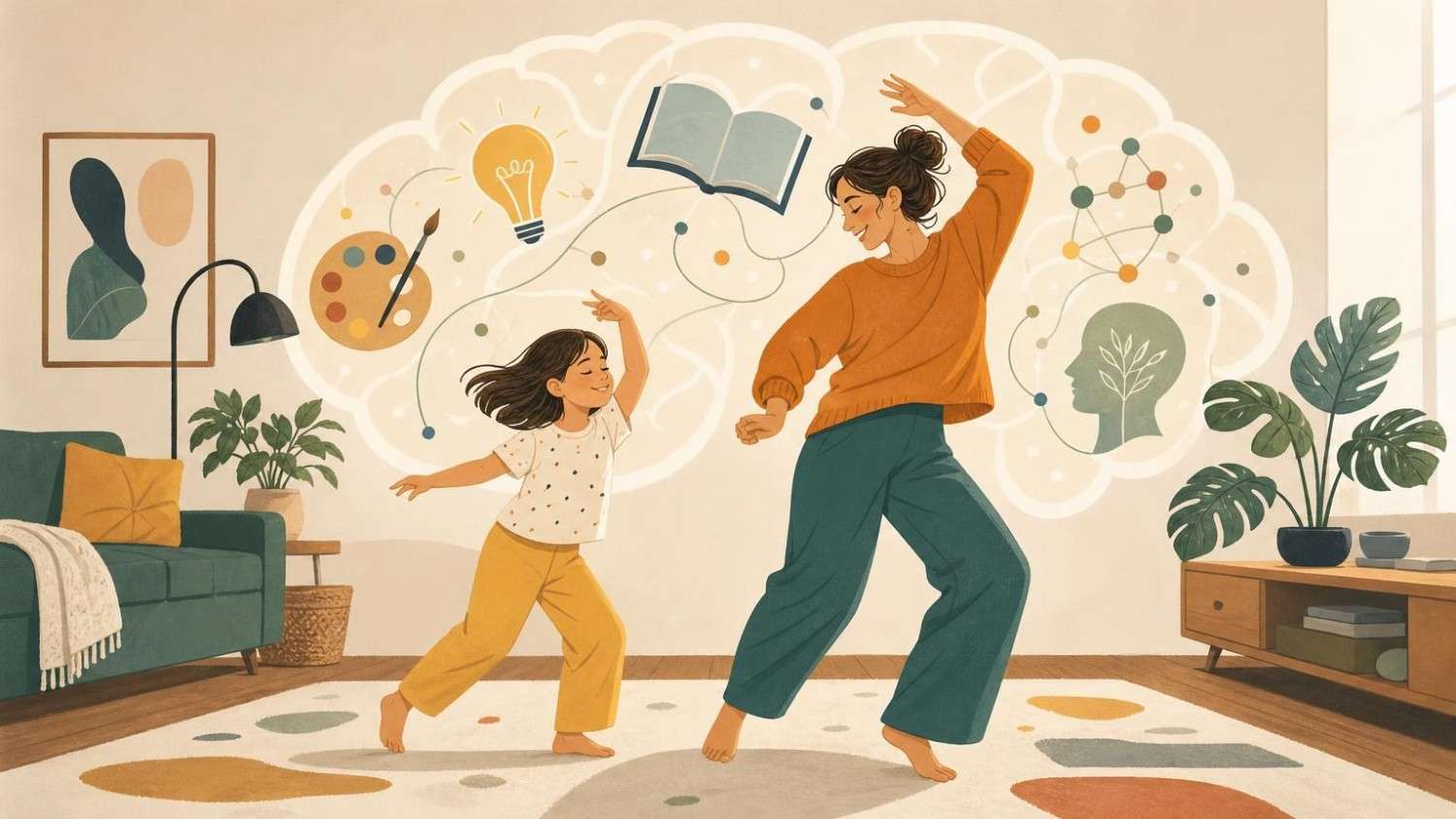
Somewhere around 6 p.m., the dishes are piled up, the kids are bouncing off the walls, and someone puts on a song. Within thirty seconds, the coffee table has been pushed aside and the whole family is stomping, spinning, and collapsing onto the couch in laughter. It looks like chaos. It feels like blowing off steam.
But here’s what’s actually happening: those five minutes of flailing to a pop song are running a surprisingly complete curriculum. Memory, balance, vocabulary, emotional regulation, and social timing are all getting a workout at once. Understanding why dancing around the living room is actually a learning activity changes how you see those evenings, and it might make you a little less guilty about skipping the flashcards.
The Living Room Stage: Redefining Play as Education
Most of us carry an unspoken hierarchy in our heads. Worksheets, reading time, and educational apps sit at the top. Free play sits somewhere near the bottom, tolerated as a break from the “real” learning. That’s a mistake, and developmental psychology has been pushing back on it for decades.
Laura Berk, a developmental psychologist at Illinois State University, has written extensively about how play is the primary way young children build self-regulation and thinking skills. Play isn’t a reward for learning. It’s the delivery system. When a four-year-old invents a “freeze dance” rule or decides that the chorus means everyone spins, they’re practicing the same mental muscles they’ll later use to follow a math procedure or hold a conversation.
The living room matters too. It’s familiar, low-stakes, and nobody is grading anything. Kids who freeze up in a structured dance class often go completely loose at home, which is exactly the condition where experimentation happens. A child who tries a ridiculous new move and falls over isn’t failing. They’re running a test and collecting data.
Think of it as a preventative investment rather than a corrective one. You’re not dancing to fix a delay or patch a weakness. You’re building a deposit of coordination, confidence, and connection that compounds quietly over months and years. A family that dances twice a week isn’t doing anything dramatic on any single night. The value shows up in the accumulation.
Neuroplasticity and the Rhythm of Cognition
The brain rewires itself based on what it does repeatedly. That’s neuroplasticity in one sentence, and it’s the reason a living room dance habit has cognitive effects that extend well past the music.
Dancing is unusual because it asks several brain systems to cooperate in real time. The auditory system tracks the beat. The motor cortex plans movement. The cerebellum fine-tunes timing and balance. Memory systems store sequences. Very few everyday activities fire all of those at once, and the coordination between them is where a lot of the benefit lives.
Executive Function and Pattern Recognition
Executive function is the brain’s management team: working memory, impulse control, and the ability to switch between tasks. Dancing trains all three, often without anyone noticing.
Consider the classic freeze dance. A child has to keep moving while listening for the music to stop, then hold perfectly still, then restart. That’s impulse control in its purest form. Add a rule like “when the song says ‘jump,’ everybody jumps,” and now working memory is involved too.
Pattern recognition shows up the moment a child notices that songs repeat. Verse, chorus, verse, chorus. The kid who starts shouting “here it comes!” before the chorus drops has detected a structure and made a prediction. This isn’t random excitement. It’s the same skill that later helps them spot patterns in number sequences or anticipate the next event in a story.
Language Acquisition Through Lyric and Beat
Songs have been used to teach language for as long as there have been parents, and the mechanism makes sense when you think about it. Rhythm breaks words into chunks, and melody makes those chunks memorable.
When a toddler belts out a half-understood lyric while stomping, they’re practicing syllable segmentation, which is a foundation of early reading. Clapping or stepping to each syllable makes that division physical. Action songs go further by pairing a word with a movement: “reach up high,” “turn around,” “touch the ground.” The body anchors the vocabulary.
A small, practical tip: pick a few songs with clear, slow lyrics and repeat them for a few weeks rather than cycling through a giant playlist. Repetition is where vocabulary sticks.
Gross Motor Mastery and Spatial Intelligence
Gross motor skills involve the big muscle groups: legs, arms, core. Running, jumping, hopping on one foot, and keeping balance all fall into this category. A good living room dance session hits nearly all of them in a few minutes.
Watch a three-year-old dance and you’ll see them experiment with movements they can’t quite do yet. They’ll try to hop on one foot and wobble. They’ll attempt a spin and lose their balance. A few weeks later, the hop is steady and the spin is controlled. That progression is motor learning, and it happens through repetition and gentle failure.
Spatial intelligence comes along for the ride. Dancing in a room full of furniture, siblings, and a dog requires constant judgment about distance and direction. How far can I swing my arms without hitting the lamp? Where is my sister going to be in two seconds? These calculations feed directly into the kind of spatial reasoning used later in geometry, map reading, and even parallel parking.
Proprioception: Mapping the Body in Space
Proprioception is the sense that tells you where your body parts are without looking. Close your eyes and touch your nose: that’s proprioception at work. It’s sometimes called the “sixth sense,” and it develops through movement.
Kids with a weak proprioceptive map often look clumsy. They bump into doorframes, press too hard with a pencil, or struggle to judge how much force to use when hugging. Dancing builds this map in a fun way because it involves constant shifts in posture, weight, and speed. Jumping, landing, crouching low, and stretching tall all send rich feedback from muscles and joints back to the brain.
One common misconception is that only “real” dance moves count. They don’t need to. A kid crawling across the floor like a snake to a funky bassline is getting excellent proprioceptive input. Animal-themed dancing (stomp like an elephant, tiptoe like a cat) is particularly good because it contrasts in force and size.
Emotional Literacy and Creative Problem Solving
Ask a five-year-old to describe frustration and you’ll likely get a blank stare. Ask them to dance like they’re frustrated, and they’ll stomp, clench their fists, and scowl. Movement gives children a way to express emotions before they have the words for them.
That’s the start of emotional literacy: recognizing feelings, naming them, and understanding how they show up in the body. You can build on it deliberately. Try a game where you call out emotions and everyone moves accordingly. Happy might mean bouncing. Sad might mean slow, droopy arms. Nervous might mean tiny, jittery steps. Afterward, talk about it: “Where did you feel the angry dance in your body?”
Music also does some of the emotional teaching on its own. A minor-key ballad and an upbeat dance track pull kids into different moods, and they start to learn that feelings can shift, sometimes quickly, and that’s okay.
Creative problem solving shows up when the rules get loose. Picture a seven-year-old who wants to do a “robot dance” but only has a slow song playing. They’ll figure out how to make it work: slow-motion robot, maybe, or a robot that’s running low on batteries. That’s divergent thinking, generating multiple solutions to an open-ended problem. It’s the same skill that drives inventing, writing, and adapting when plans go sideways. A living room with no choreographer is a perfect training ground for it.
The Social Synchrony of Family Dance Parties
Something interesting happens when people move together to the same beat. They start to feel more connected. Researchers call this behavioral synchrony, and it’s one reason dancing has shown up in nearly every human culture on record.
In a family setting, synchrony builds a sense of “us.” When a parent and child clap on the same beat or hit the same pose at the chorus, there’s a small spark of shared accomplishment. Repeat that a few hundred times over a childhood and you’ve built a reservoir of positive shared experiences. It works a bit like compound interest: each dance party is a small deposit, and the relationship gains value over time.
Family dancing also teaches social skills that are hard to drill directly:
- Turn-taking: “Your turn to pick a move, then everyone copies it.”
- Leading and following: Kids practice both roles, which builds flexibility.
- Reading cues: Noticing when someone wants to stop, slow down, or join in.
- Handling small conflicts: Two kids want different songs. They have to work it out.
Mirror Neurons and Empathetic Connection
In the 1990s, Giacomo Rizzolatti and his team at the University of Parma identified neurons in monkeys that fired both when the animal performed an action and when it watched another perform the same action. These became known as mirror neurons, and they’ve been linked, with ongoing debate about the details, to how we understand and imitate others.
Copying games tap into this directly. When a child mirrors your arm movements in real time, they have to watch closely, predict your next move, and match it with their own body. That close attention to another person is a building block of empathy. You’re essentially practicing “what is this person doing and why?” over and over.
A simple version: stand facing each other and pretend to be reflections. Move slowly at first. Then swap who leads. Kids find it hilarious, and it trains focused, attuned attention.
Sensory Integration and Stress Regulation
Sensory integration is the brain’s process of organizing information from the senses: sound, sight, touch, balance, and body position. Dancing floods the system with all of them at once, which is why it can feel both energizing and oddly calming.
Spinning and swinging stimulate the vestibular system in the inner ear, which governs balance. Stomping and jumping give heavy, grounding input to muscles and joints. Music adds rhythmic auditory structure. For many kids, especially those who get easily overwhelmed, this kind of organized sensory input helps the nervous system settle.
Stress regulation works through a similar path. Physical movement burns off some of the stress chemistry that builds up during a long day, and rhythmic activity tends to steady breathing. You’ve probably seen it: a cranky, wired kid dances hard for two songs and then flops onto the rug, noticeably calmer. That shift is partly physical release and partly the brain moving into a more regulated state.
Here’s a structure that works well for wind-down dancing:
- Start with one fast, high-energy song to burn off restlessness.
- Follow with a medium-tempo song with bigger, slower movements.
- Finish with something slow, with stretching or swaying.
One mistake parents often make is ending on the most exciting song right before bed. That leaves kids wound up. Taper the energy down instead, and the dance session becomes a bridge into calm rather than a launchpad.
Turning the Carpet into a Classroom for Life
The case for living room dancing as real learning rests on how much it packs into so little time: executive function, language, motor skill, body awareness, emotional vocabulary, social timing, and stress regulation, all from a playlist and some cleared floor space.
Keep the routine simple. You don’t need a dozen apps or a structured program. Three or four core habits beat an elaborate plan you’ll abandon in two weeks:
- A short, regular slot: ten minutes after dinner, three times a week.
- One rule-based game: freeze dance or copy-the-leader.
- One emotion or animal prompts a stretch expression.
- A calming final song to close.
If you want to see whether it’s helping, track a few things for a month. Note how long it takes your child to settle at bedtime on dance nights versus other nights. Watch for steadier balance, like hopping on one foot for longer. Listen for new words picked up from songs. Rate your kid’s evening mood on a simple 1 to 5 scale before and after dancing.
The beauty of this habit is that nobody has to know it’s educational. Your kids just think you’re fun. Let them keep thinking that, and turn up the music.